Kitchen & Tableware ·
10 Essential Japanese Kitchen Tools, Recommended by a Licensed Cook
This post contains affiliate links. If you buy through them, I may earn a small commission at no extra cost to you.
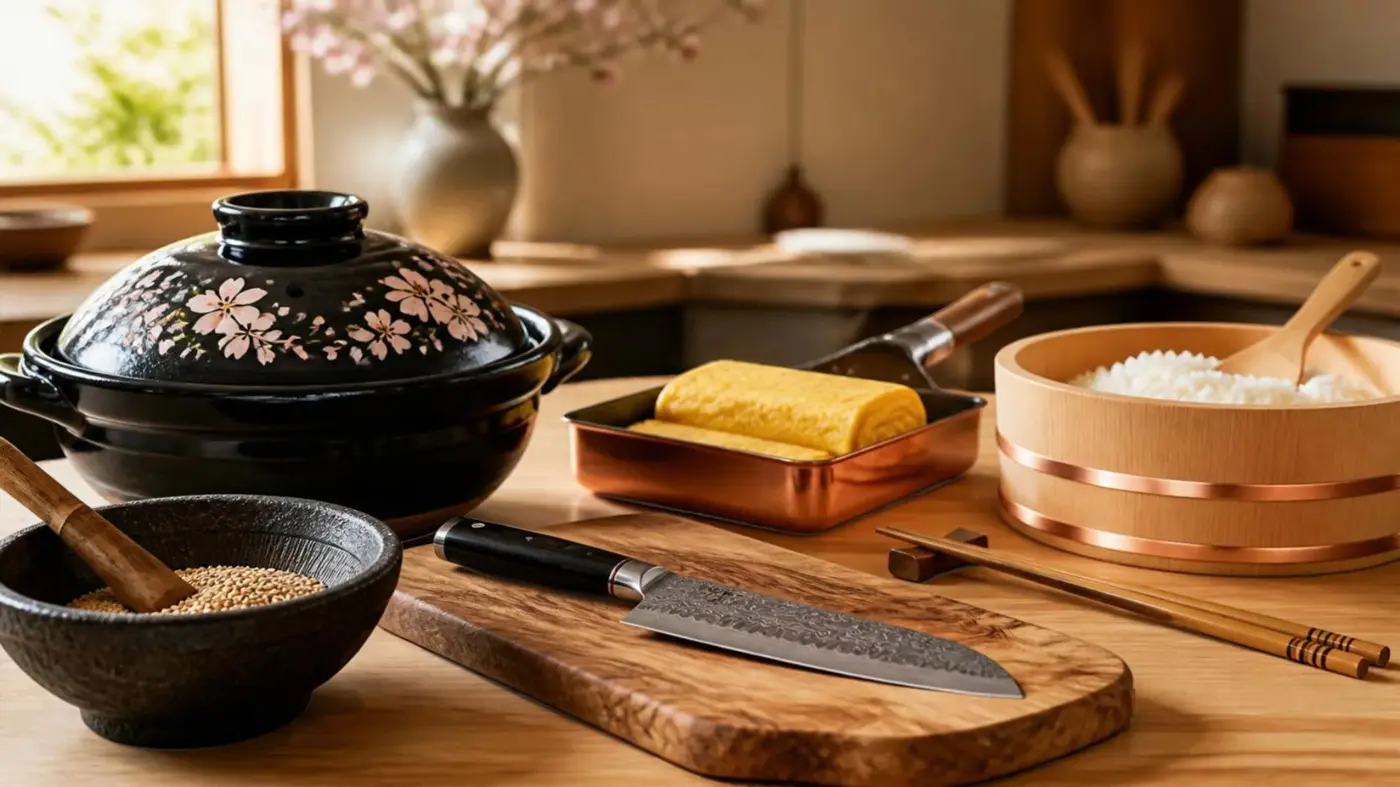
Japanese kitchens are often small, so the tools in them have to earn their place: each one does a job well, does more than one job, and lasts for years with a little care. As a licensed cook (chōrishi) in Japan, I picked ten tools that make Japanese home cooking easier and more enjoyable — from the knife you will reach for every day to the wooden tub that turns rice into sushi rice. Every tool below is listed as made in Japan, and each comes with a short tip from the kitchen.
Want to see the featured pick?
How to choose Japanese kitchen tools
Look at the material first. Steel and stainless steel for blades, clay for slow and even heat, copper for fast and precise heat, and wood or bamboo for anything that touches rice or simmers gently. Each material has its own care, and that care is part of how the tool gets better with age.
Then look at where it was made. Japan has regions famous for each craft: Niigata (Tsubame-Sanjo) and Gifu (Seki) for blades and metalwork, Mie (Banko ware) for clay pots, and Gifu again for Mino ware pottery. A tool from one of these places usually carries generations of know-how.
Finally, start with what you will use most. A good knife, a way to keep it sharp, and a pot of well-cooked rice will change your cooking more than any single gadget.
- 01
1. Tojiro DP Damascus Santoku Knife (7 Inch)
Our top pick and the tool you will use every day. Tojiro forges this santoku in Japan with a VG-10 cobalt alloy steel core clad in 37 layers of Damascus steel, hardened to about 60 on the Rockwell scale — sharp out of the box and easy to maintain. The thin blade handles vegetables, fruit, and meat, and the micarta handle with three stainless rivets and a bolster gives it good balance. Backed by a lifetime warranty. Chef’s tip: never use it on bones or frozen food — that is the quickest way to chip a fine Japanese edge.
View on Amazon (paid link) - 02
2. KING 1000/6000 Whetstone Starter Set
A complete starter kit built around a KING combination whetstone made in Japan: a 1000-grit side for sharpening and a 6000-grit side for finishing. It comes with an angle holder that keeps the blade at a steady angle, a stable base, and a wiping cloth, so it is an easy first step into sharpening Japanese knives. Chef’s tip: soak the stone in water for 10 to 15 minutes, until bubbles stop rising, before you start.
View on Amazon (paid link) - 03
3. Zojirushi NW-JEC10 Pressure Induction Heating Rice Cooker (5.5 Cups)
Made in Japan and built for US kitchens. Pressure cooking and steaming help the rice cook through for a soft, slightly chewy texture, and the cooker automatically chooses among pressure levels depending on the menu, then releases pressure at the end of steaming to drive off excess moisture. It holds up to 5.5 cups of uncooked rice and comes with a rice spatula, a spatula holder, and a measuring cup. Chef’s tip: let rinsed rice soak for about 30 minutes before cooking — especially on quick settings — so every grain cooks plump to the center.
View on Amazon (paid link) - 04
4. COTONOHA Banko Ware Donabe Clay Pot (Cherry Blossom)
Handmade in Yokkaichi, Mie — the home of Banko ware, a pottery tradition dating back to the 18th century. Cherry blossoms on a deep black glaze make it pretty enough to bring straight to the table for hot pot, sukiyaki, shabu-shabu, or rice. It comes in two sizes: the smaller one for one or two people, the larger for families and groups. Before first use, simmer rice-rinsing water or vegetable peels in it for about 10 minutes to season the clay. Chef’s tip: never put a wet pot over the flame or heat it empty — sudden temperature changes are what crack clay.
View on Amazon (paid link) - 05
5. TIKUSAN Copper Tamagoyaki Pan with Wooden Lid
A square copper pan made in Japan using methods handed down since the Edo period. Copper heats quickly and evenly, which is the secret to soft, fluffy rolled omelets, and the tin-lined interior keeps any metallic smell out of your food. The wooden lid helps shape the roll and turn it out onto a plate. Not for induction or the dishwasher; wash with hot water and a soft sponge, without dish soap, to keep the seasoning. The wooden handle attaches before first use, and the copper will darken naturally with age. Chef’s tip: pour the egg in three or four thin layers, pushing each rolled layer to the far side of the pan before adding the next.
View on Amazon (paid link) - 06
6. TIKUSAN Mino Ware Suribachi & Surikogi with Spout (Black)
A Japanese mortar and pestle in traditional Mino ware. The ridged inside grinds sesame, garlic, herbs, whole spices, and nuts into fragrant pastes and powders, and the spout makes it easy to pour out dressings and sauces. About 6.5 inches across and 3.1 inches tall, with a wooden pestle — and handsome enough to serve from. Chef’s tip: lightly toast sesame seeds before grinding; the aroma becomes much deeper.
View on Amazon (paid link) - 07
7. TIKUSAN Wooden Wasabi Grater with Bamboo Brush
A traditional grater made in Japan from natural wood with fine stainless steel teeth, about 5.5 × 3 inches. It turns fresh wasabi into a soft, fragrant paste, and it works for ginger and garlic too. A bamboo brush (made in China) is included for sweeping every bit off the teeth. Rinse in cold water only and dry well after use. Chef’s tip: grate slowly in small circles — with fresh wasabi it brings out the aroma, and with daikon on a larger grater the same gentle motion keeps the heat mild.
View on Amazon (paid link) - 08
8. WASHO Kiso Sawara Wooden Drop Lid (Otoshibuta)
An otoshibuta rests directly on the food inside the pot, not on the rim, so heat and flavor spread evenly and delicate ingredients do not tumble or break apart. This one is made in Japan from water-resistant sawara cypress — the wood used for sushi tubs and rice chests — and has a wider handle than most (33 mm instead of 22 mm), so it is easy to lift out of hot broth. It is about 9 inches across; choose a lid 2 to 3 cm smaller than your pot, and wet it well before each use. Chef’s tip: even with only a little simmering liquid, the lid carries the flavor all through the dish and keeps it from falling apart.
View on Amazon (paid link) - 09
9. Tanaka Hashi Bamboo Cooking Chopsticks (Saibashi, 13 Inch)
Long bamboo cooking chopsticks made in Japan by a company founded in Fukui in 1948. At 13 inches they reach the bottom of deep pots and keep your hands away from heat, and the anti-slip tips grip slippery food. Use them for stir-frying, scrambling eggs, deep-frying, and plating. Check the listing for the current design. Chef’s tip: dip the tips into hot oil — when fine bubbles rise steadily from them, the oil is at a medium frying temperature, about 340–355°F (170–180°C).
View on Amazon (paid link) - 10
10. Sawara Hangiri Sushi Rice Tub with Lid (10.6 Inch)
A wooden hangiri (sushi oke) handmade in Japan from sawara cypress with a sturdy copper band — just the right size for home, serving two to three people. Use it to fold vinegar into freshly cooked rice, then put the lid on to keep it, or serve chirashi sushi right in the tub. Sawara has a fine grain that resists shrinking as it dries and a gentle scent that pairs beautifully with vinegar. The tub is about 10.6 inches (27 cm) across and 3.5 inches (8.8 cm) deep, with a matching lid. Wet it before use so the rice does not stick, and wash by hand (not dishwasher-safe). In warm weather a little natural sap may appear on the wood; it is harmless and rinses off with water, and the copper band may darken over time. Chef’s tip: the wood absorbs extra moisture from the rice, so your sushi rice turns out glossy instead of sticky.
View on Amazon (paid link)
A cook's tips for making tools last
Dry steel right away. Even stainless knives keep their edge longer when they are washed by hand and wiped dry instead of going through the dishwasher.
Let wood and bamboo breathe. Do not leave wooden tools soaking; rinse them, wipe them, and let them air-dry fully before putting them away so they stay free of mold and odors.
Treat clay gently. Season a new donabe before first use, avoid sudden temperature changes, and make sure it is completely dry before storing it.
Bring Japan to the table
Once the cooking is done, the table is the next step. If you are shopping for someone who loves Japanese food and drink, see our Japanese sake gifts chosen by a sommelier, or browse more ideas in our gifts for Japan lovers guide.